

Every "best AI writing tools" list I've read this year follows the same formula. List 15 tools. Give each one two paragraphs of features. Slap a "best for X" label on it. Call it a day. Nobody actually tells you which tool to pick for your specific situation, or whether any of these tools are worth paying for when you could just use ChatGPT directly.
Let me fix that. I've tested these tools on real projects. Blog posts, landing page copy, email sequences, product descriptions. Not demo content. Real work with real deadlines. Here's what I found about each AI content writing tool and when it actually makes sense to use one.
The Honest Truth About AI Content Writing Tools in 2026
Before we compare anything, let's address the elephant in the room. You can do 80% of what these tools offer by prompting ChatGPT or Claude directly. Seriously. If you know how to write a good prompt with context, brand guidelines, and specific instructions, you'll get quality output from any frontier model.
So why do AI content writing tools exist? Three reasons.
Workflow automation. Going from "I need a blog post about X" to a published, optimized article involves a dozen steps. Research, outline, draft, optimize, format, publish. Tools like Jasper and Writesonic package these steps into guided workflows that save time, especially for teams where not everyone is a prompt engineering expert.
Optimization intelligence. Raw AI output doesn't consider SEO. It doesn't know what's ranking for your target keyword or what terms to include. Content writing tools that integrate optimization data (like Surfer, Frase, or Gondla) feed this intelligence into the writing process so the output is search-ready from the start.
Consistency at scale. When you're producing 20+ articles per month across multiple writers, maintaining quality and brand voice gets hard. Tools with brand voice training, content scoring, and template systems provide guardrails that keep output consistent regardless of who's writing.
If you don't need any of these three things, save your money and use ChatGPT with well-crafted prompts. If you do need them, keep reading.
The Best AI Content Writing Tools, Ranked by What Actually Matters
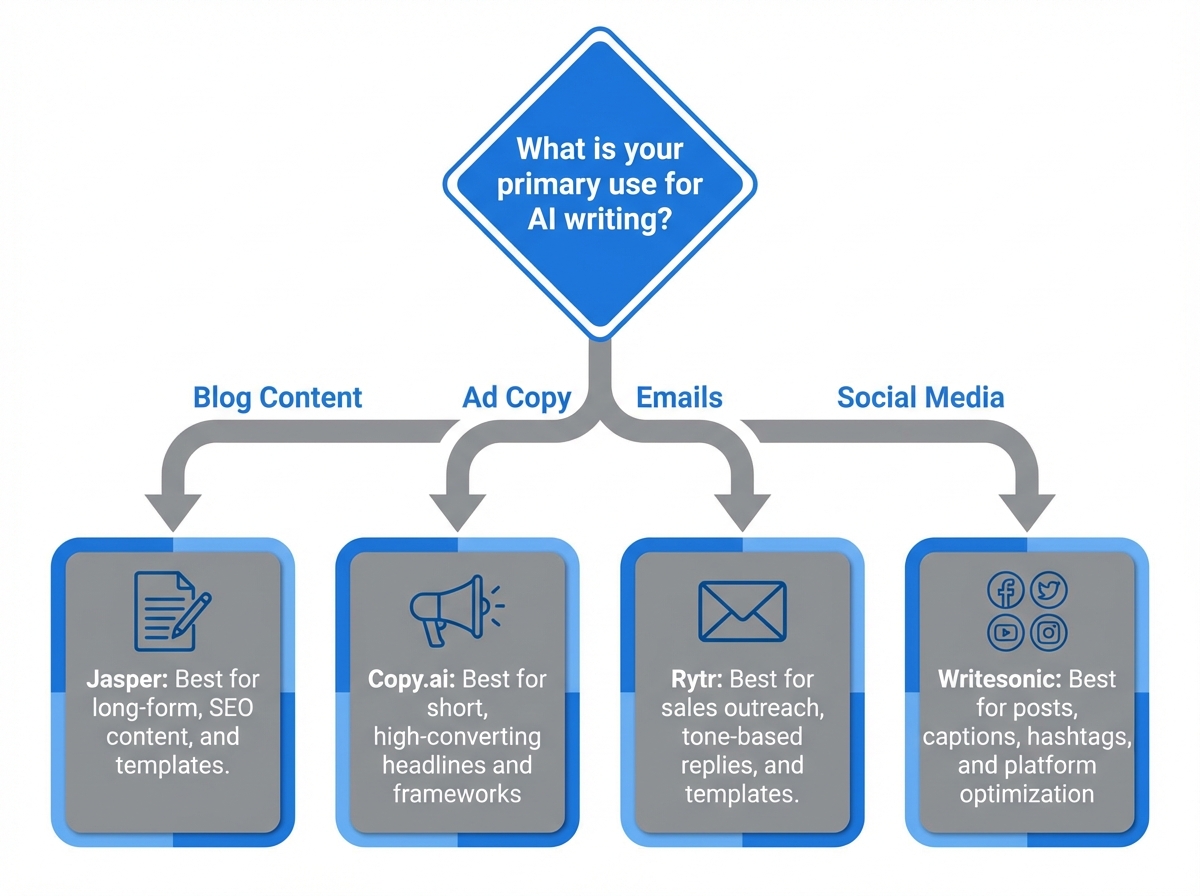
I'm organizing this by use case, not by some arbitrary "overall best" ranking. The right tool depends entirely on what you're trying to produce.
Best for SEO Blog Content: Gondla
If your primary goal is blog posts that rank on Google AND get cited by AI assistants, Gondla is the strongest option right now. And I'm not just saying that because of the price (though the price helps).
Gondla's BYOK (Bring Your Own Key) model means you connect your own API keys from OpenAI, Anthropic, or Google. You're using the same frontier models as everyone else, but paying API rates instead of per-seat SaaS pricing. Total cost: roughly $15-30/month versus $99-219/month for comparable tools.
But the real differentiator is dual-channel optimization. Most AI writing tools help you write for Google. Gondla also tracks whether your content gets cited by ChatGPT, Gemini, and Perplexity through its Citation Radar feature. You're not just publishing content and hoping AI assistants notice. You're measuring and optimizing for both discovery channels from one platform.
With access to 15+ AI models, you can pick the best model for each task. Claude for long-form nuanced content. GPT for structured SEO articles. Gemini for research-heavy pieces. This flexibility beats being locked into whatever single model a tool bundles.
Best for: Teams producing SEO blog content who want both Google rankings and AI visibility at a fraction of the usual cost.
Best for Marketing Teams: Jasper
Jasper has earned its reputation. For marketing teams that produce high volumes of varied content (ads, social posts, emails, landing pages, blog posts), Jasper's template library and brand voice training are genuinely useful. It pulls from multiple AI models including GPT, Gemini, and Claude to match the best model to each task.
The campaign feature is where Jasper shines. Give it a product brief, and it generates coordinated content across formats: blog post, email sequence, social posts, ad copy. Not perfect output, but solid first drafts that save hours of starting from scratch.
The downside is price. Jasper starts at $49/month for the Creator plan (single user) and $125/month for the Pro plan (up to 10 users). For what you get, that's fair if you're using it daily across multiple content types. If you're only writing blog posts, you're overpaying for features you'll never touch.
Best for: Marketing teams producing diverse content types who value workflow automation and brand consistency.
Best for Short-Form Conversion Copy: Copy.ai
Copy.ai has carved out a niche in short-form content that converts. Headlines, CTAs, email subject lines, product descriptions, ad copy. Where it stands out is the iteration workflow. It doesn't just generate and dump. It prompts you for feedback, suggests variations, and refines based on your direction.
The workflow automation features are solid for sales teams. You can chain together prospecting research, personalized outreach drafts, and follow-up sequences. For performance marketing teams running dozens of ad variants, the speed advantage is real.
Copy.ai is weaker on long-form content. Blog posts and guides come out thin and generic. If your content strategy is blog-heavy, look elsewhere.
Best for: Performance marketing and sales teams focused on conversion copy and outreach.
Best for Research-Heavy Content: Claude (Direct)
For content that requires depth, nuance, and accurate synthesis of complex topics, using Claude directly (through the API or interface) often beats dedicated writing tools. Claude's Projects feature lets you load brand guidelines, audience personas, source material, and style references that persist across conversations.
The output quality for B2B content, thought leadership, and technical writing is consistently the best I've seen from any model. It follows instructions precisely, maintains tone across long pieces, and handles multi-step reasoning well. The trade-off is that you're managing the workflow yourself. No optimization scoring. No content templates. No team collaboration features. You need prompt engineering skills and a separate optimization workflow.
Best for: Solo creators or small teams producing research-heavy, long-form content who are comfortable with prompt engineering.
Best for Budget-Conscious Teams: Rytr
If your budget is under $30/month total and you need an AI content writing tool with a guided interface, Rytr is the simplest option. It handles basic blog posts, social media content, and email drafts at an accessible price point.
The quality ceiling is lower than premium tools. Output tends to be more generic and requires heavier editing. But for solopreneurs and early-stage startups where any AI assistance beats none, it does the job.
Best for: Solo operators and bootstrapped startups who need affordable AI writing assistance.
Quick Comparison Table
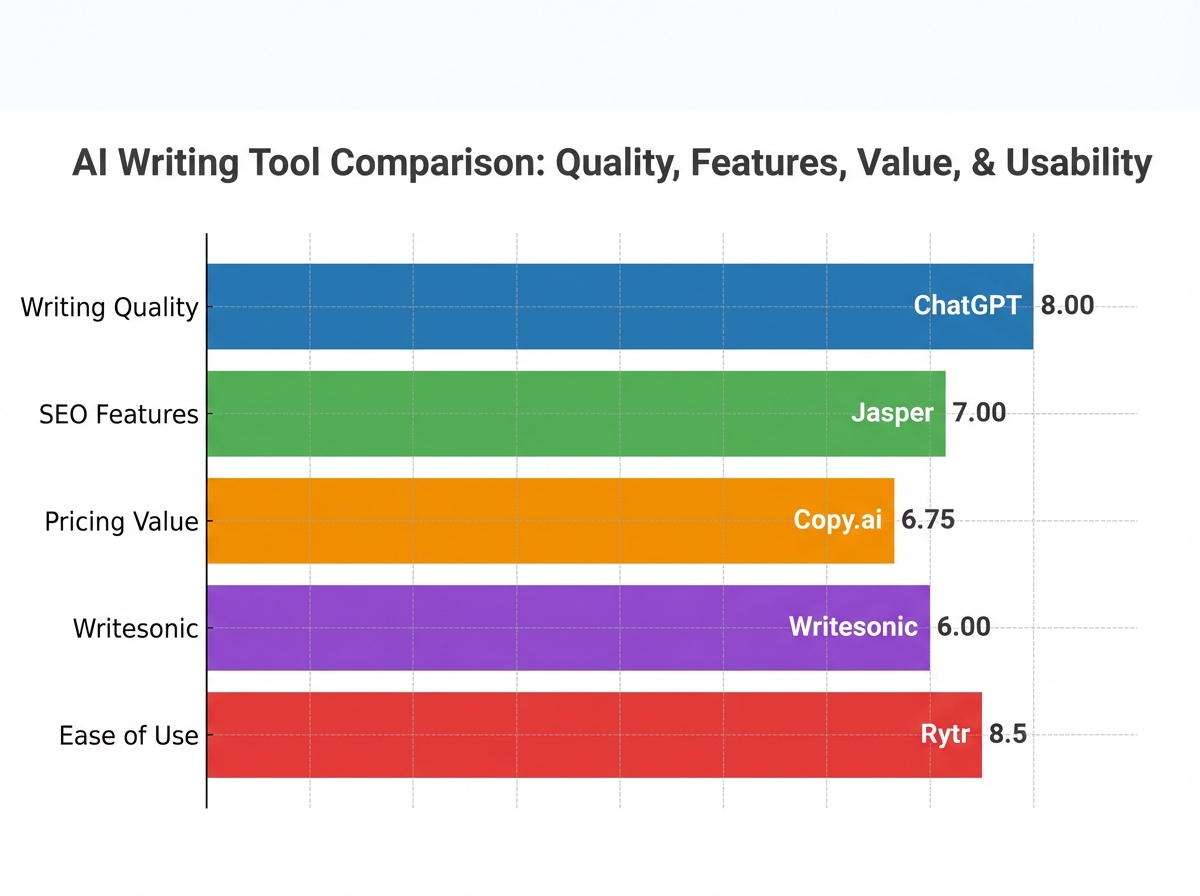
| Tool | Starting Price | Best For | AI Models | SEO Features | AI Visibility |
|---|---|---|---|---|---|
| Gondla | ~$15-30/mo (BYOK) | SEO blog content | 15+ (your choice) | Yes | Yes (Citation Radar) |
| Jasper | $49/mo | Marketing teams | Multi-model | Basic | No |
| Copy.ai | $36/mo | Conversion copy | GPT-based | No | No |
| Claude | API pricing | Research content | Claude only | No | No |
| Writesonic | $16/mo | General content + AEO | GPT-based | Yes | Partial |
| Rytr | $9/mo | Budget writing | GPT-based | Basic | No |
| Surfer SEO | $99/mo | Content optimization | Basic AI | Yes (strong) | No |
How to Actually Choose (The Decision Framework)
Stop comparing feature lists. Ask yourself these four questions instead.
What content are you producing? If it's mostly blog posts for SEO, you need a tool with optimization intelligence (Gondla, Surfer, Frase). If it's mostly ads and emails, optimization doesn't matter as much (Copy.ai, Jasper). If it's thought leadership and research, use a frontier model directly (Claude).
What's your monthly volume? Under 10 articles, any tool works. Over 10, workflow efficiency and consistency features start paying for themselves. Over 30, team features, brand voice training, and publishing integrations become essential.
Do you care about AI visibility? If you want your content cited by ChatGPT and Gemini (you should), you need a tool that tracks AI citations. Right now, Gondla is the only AI content writing tool that includes this as a core feature.
What's your budget math? Add up what you're spending across AI writing, SEO optimization, and tracking tools. If the total is over $200/month, a BYOK platform like Gondla that consolidates these into one $15-30/month cost might save you real money without sacrificing capability.
Common Mistakes When Choosing an AI Content Writing Tool
Paying for models you can access directly. If a tool charges $99/month primarily to give you access to GPT or Claude, compare that against the $20-30/month you'd spend accessing those same models directly through API keys. The tool needs to add enough value through workflow, optimization, or team features to justify the markup.
Ignoring the editing requirement. No AI content writing tool produces publish-ready content. Zero. The best tools produce better first drafts that need less editing. But every piece needs a human pass for voice, accuracy, and strategic alignment. Factor editing time into your tool evaluation.
Choosing based on the AI writing quality alone. The writing quality difference between top-tier tools is smaller than you'd think. They all use the same underlying models. The real differentiator is everything around the writing: optimization data, workflow automation, team features, and analytics. Compare those.
Forgetting about discovery. A perfectly written article that nobody finds is worthless. The best AI content writing tool isn't just the one that writes well. It's the one that helps your content get discovered in both traditional search and AI-generated answers.
Frequently Asked Questions
What is the best AI content writing tool in 2026?
It depends on your use case. For SEO blog content with AI visibility tracking, Gondla offers the best value with its BYOK pricing model and Citation Radar. For marketing teams producing diverse content types, Jasper is the most complete platform. For short-form conversion copy, Copy.ai specializes in that niche. There's no single "best" tool for everyone.
Are AI content writing tools worth paying for?
Only if they save you more time or produce better results than using ChatGPT or Claude directly with good prompts. The value comes from workflow automation, SEO optimization intelligence, and team consistency features. If you're a solo creator comfortable with prompt engineering, the free tiers of frontier models might be all you need.
Can AI writing tools replace human writers?
Not for quality content. AI tools produce drafts that need human editing for brand voice, factual accuracy, strategic alignment, and emotional resonance. The best results come from human-AI collaboration where AI handles the speed-intensive parts (first drafts, variations, research synthesis) and humans handle judgment-intensive parts (strategy, voice, persuasion).
How much do AI content writing tools cost?
Ranges vary widely. Budget options like Rytr start at $9/month. Mid-tier tools like Writesonic and Copy.ai run $16-49/month. Premium tools like Jasper cost $49-125/month. Enterprise tools like Surfer start at $99/month. BYOK platforms like Gondla cost $15-30/month total including API usage, which is typically the best value for teams producing SEO content.
Do AI writing tools help with SEO?
Some do, some don't. Tools like Gondla, Surfer, and Frase integrate SEO data directly into the writing process, suggesting keywords, content structure, and optimization targets. General-purpose tools like Copy.ai and Rytr focus on writing quality without SEO intelligence. For content meant to rank, choose a tool with built-in optimization features.
Created with Gondla - The AI content writing tool with BYOK pricing and AI visibility tracking.