

I'm going to say something that might upset both camps. AI copywriting tools aren't going to replace writers. But writers who refuse to use AI are going to lose to writers who do.
That's not a prediction. It's what's already happening. The copywriters producing the best work right now are the ones who've figured out where AI helps and where it hurts. They use it for the boring parts (first drafts, research summaries, headline variations) and bring their own brain for the parts that actually matter (strategy, voice, persuasion, knowing when to break the rules).
AI copywriting is simply using artificial intelligence to help generate written content for marketing, sales, and brand communication. The "help" part is the word most people miss. Help. Not replace. Not automate. Help.
Here's the practical guide to making it work.
Why AI Copywriting Took Off (And Where It Actually Stands)
Let's rewind a minute. Three years ago, AI writing tools could produce passable blog posts that read like a Wikipedia article had a baby with a content mill. Grammatically correct. Factually sketchy. Totally devoid of personality. Most marketers tried them, got disappointed, and moved on.
Fast forward to 2026 and the gap has closed dramatically. Models like Claude, GPT, and Gemini can now produce first drafts that are surprisingly good. Not perfect. Not ready to publish. But good enough that editing an AI draft is faster than writing from scratch for most standard content.
The tools have gotten smarter too. Jasper lets you train the AI on your brand voice. Copy.ai automates entire workflow sequences. Writesonic bakes in SEO and Answer Engine Optimization. Each tool has carved out its niche. But here's the thing nobody selling these tools will tell you: the output is only as good as the input. Feed it a lazy prompt and you'll get lazy copy. Feed it a detailed brief with context, audience info, and specific examples to reference? Now you're getting somewhere.
The real shift isn't the technology. It's the workflow. The best marketers have stopped asking "can AI write this?" and started asking "what's the most efficient way to produce this at the quality my audience expects?" Sometimes the answer involves AI heavily. Sometimes barely at all.
What AI Copywriting Is Good At (And Where It Falls Apart)
Let me save you some trial and error. After working with these tools extensively, here's where they genuinely help and where they reliably fail.
Where AI Copywriting Excels
First drafts and raw material. Getting from blank page to something you can work with is where AI saves the most time. A 2,000-word first draft that takes 30 minutes to write takes 3 minutes to generate and 15 minutes to edit. That math works.
Variations and alternatives. Need ten headline options? Twenty subject line variations? Five different angles on the same value proposition? This is AI's sweet spot. It generates volume fast, and you pick the winners. I've found that out of twenty AI-generated headlines, one or two are usually better than what I would have written from scratch. The rest are mediocre, which is fine because you're cherry-picking.
Structured content. Product descriptions, feature comparisons, FAQ answers, technical documentation. Content with clear formats and known patterns. AI handles these reliably because the structure constrains the output.
Research synthesis. Give AI a bunch of source material and ask it to summarize key points, identify themes, or draft an outline. It's excellent at processing large amounts of information and organizing it logically. This saves hours on research-heavy projects.
Where AI Copywriting Fails
Brand voice. Every AI tool claims to "learn your brand voice." In reality, they approximate it. They can match tone broadly (formal vs casual, technical vs simple) but they miss the subtle patterns that make your voice distinctly yours. The specific metaphors you use. The topics you reference. The way you break grammar rules on purpose. Voice is still a human job.
Persuasion and emotion. AI can write copy that's logically correct. It struggles to write copy that's emotionally compelling. It doesn't know what it feels like to face your customer's specific frustration. It can't draw on personal experience to create connection. Copy that moves people to act requires understanding people, and that's still firmly in human territory.
Strategy and positioning. AI doesn't know your market like you do. It can't decide whether to position against your biggest competitor or differentiate on a dimension nobody's talking about. It can't feel that a particular angle is about to trend. Strategic decisions need context, judgment, and market intuition that no model has.
Humor that actually lands. AI humor is like a dad joke algorithm. Technically jokes. Rarely funny. If your brand uses wit, sarcasm, or cultural references, write those lines yourself.
The AI Copywriting Workflow That Actually Works
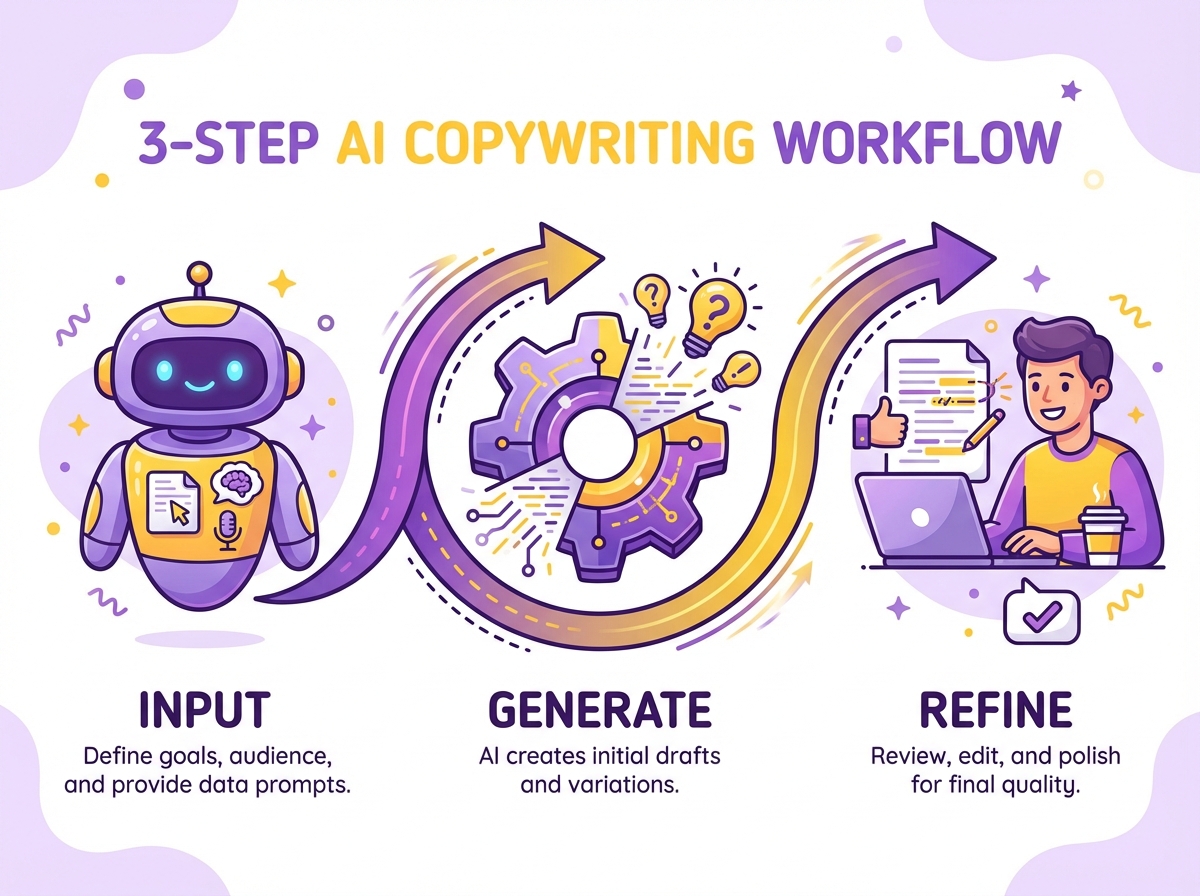
Forget "just ask ChatGPT to write it." That's the amateur approach. Here's the workflow that produces copy worth publishing.
Step 1: Brief Like a Pro
The quality of AI output correlates directly with the quality of your input. A detailed brief isn't optional. Include: who the audience is (specific segment, not "everyone"), what you want the copy to achieve (specific action, not "awareness"), the tone and voice parameters, key messages and proof points to include, examples of copy you like, and what to explicitly avoid.
A brief that takes five minutes to write saves thirty minutes of editing. Every time.
Step 2: Generate Multiple Versions
Don't generate one draft and edit it. Generate three to five versions with different angles, tones, or structures. Then pick the strongest one as your starting point. This approach leverages what AI does best (volume and variation) while keeping creative direction in your hands.
Ask for specific variations: "Write version A with a problem-first hook, version B with a stat-first hook, and version C with a story-first hook." This gives you genuinely different options rather than five rewrites of the same structure.
Step 3: Edit with Purpose
This is where the human value lives. Your editing pass should do four things.
Fix the voice. Replace generic phrasing with your specific language. If the AI wrote "We provide solutions for modern teams," change it to whatever you'd actually say. Probably something more specific and less corporate.
Add the specifics. AI writes general. You add the specific data points, named examples, real customer quotes, and concrete details that make copy believable. "Our tool saves time" becomes "Marketing teams using [Product] cut their campaign launch time from 3 weeks to 4 days."
Kill the filler. AI loves padding. Sentences that restate what was just said. Transitions that add nothing. Qualifiers that weaken your claims. Cut ruthlessly. If a sentence doesn't add information or advance your argument, delete it.
Inject the emotion. What does it feel like to have the problem you're solving? What does relief look like when your product works? Add the human moments the AI can't manufacture.
Step 4: Optimize for Search and AI
Once your copy reads well to humans, add the optimization layer. For traditional SEO, make sure your primary keyword appears in the title, first paragraph, and at least one heading. For AI visibility, add clear summary statements and FAQ sections that AI assistants can extract and cite.
Tools like Gondla help you optimize for both channels simultaneously, tracking whether your content ranks on Google and gets cited by AI assistants like ChatGPT. This dual optimization is what separates good copywriting from copy that actually drives discovery.
Best AI Copywriting Tools in 2026
Quick rundown of what's worth your time right now.
Jasper is the market leader for marketing teams. It connects to multiple AI models (GPT, Gemini, Claude), lets you train on your brand voice, and has templates for basically every marketing format. Strong for teams that produce high volume. Pricing starts around $49/month.
Claude (by Anthropic) stands out for nuanced, long-form writing. The Projects feature lets you load brand guidelines, audience personas, and reference material that Claude maintains across conversations. Best for B2B teams that need depth over speed. Available through the API with BYOK pricing.
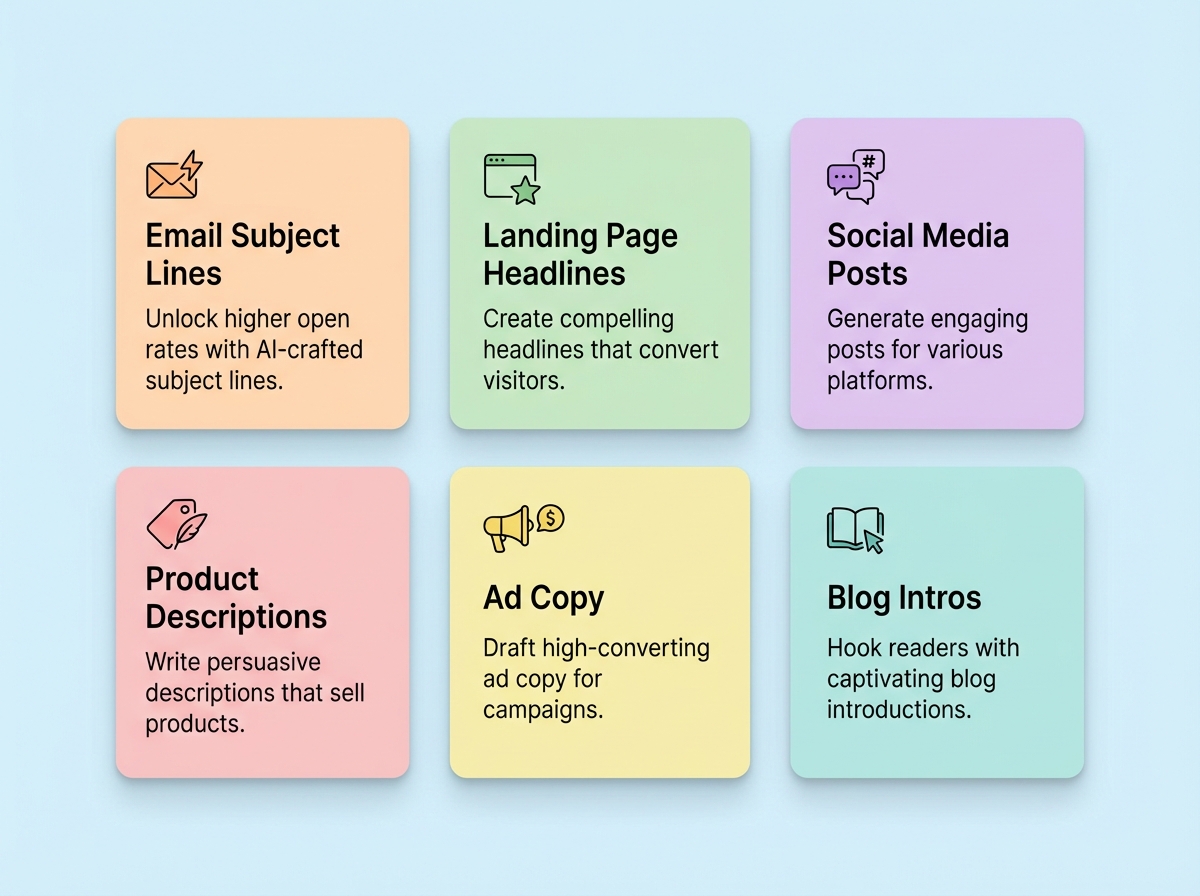
Copy.ai specializes in short-form conversion copy. Headlines, CTAs, email subject lines, ad copy. It also has workflow automation for chaining multiple copy tasks together. Best for performance marketing teams.
Writesonic has leaned heavily into SEO optimization, including Answer Engine Optimization features that help your content perform in AI search results. Good balance of writing quality and SEO functionality.
Anyword focuses on predictive performance. It scores your copy based on predicted engagement and conversion rates, which is useful for teams that run lots of ads and emails where small copy differences matter.
For teams that want to bring their own API keys and avoid per-seat pricing, platforms like Gondla let you connect your preferred AI models while adding SEO optimization and AI visibility tracking on top. This BYOK approach can cut AI content costs by 80-90% compared to per-seat tools.
Mistakes That Make AI Copywriting Worse
These will tank your results. Avoid them.
Publishing first drafts. The number one mistake. AI output is a starting point. Publishing it without human editing produces generic, forgettable content that sounds like every other AI-generated page on the internet. Always edit. Always add your voice.
Using AI for everything. Some copy shouldn't be AI-assisted. Your founder's personal story. A heartfelt customer apology. A bold brand manifesto. Content that requires genuine emotion or vulnerability falls flat when AI writes it. Know when to put the tool down.
Skipping fact-checking. AI models hallucinate. They make up statistics, invent studies, and attribute quotes to people who never said them. Every factual claim in AI-generated copy needs verification. One fake stat caught by a reader destroys more trust than a hundred good articles build.
Prompt laziness. "Write me an email about our new feature" is not a brief. "Write a launch announcement email for [feature name] targeting marketing managers at mid-size SaaS companies. Tone: excited but not salesy. Key benefit: saves 5 hours per week on reporting. Include a specific CTA to start a free trial. Keep it under 200 words." That's a brief.
Ignoring brand consistency. If your website sounds like a chill startup and your emails sound like a corporate law firm because different AI prompts produced different tones, your brand feels schizophrenic. Maintain a brand voice guide and reference it in every AI prompt.
The Future of AI Copywriting
Two things are becoming clear.
First, the gap between AI-generated and human-written copy is narrowing for straightforward content. Product descriptions, basic blog posts, social media captions. For these formats, AI output with light editing is approaching human quality. Writers who only produce this type of content are genuinely at risk.
Second, the premium on strategic, voice-driven, emotionally intelligent copy is increasing. As AI floods the internet with competent-but-generic content, the copy that stands out is the stuff with a real perspective. A distinctive voice. Genuine insight. That's harder to produce and more valuable to brands. The best copywriters are becoming more like creative directors who use AI as one tool among many.
For marketers, the practical takeaway is straightforward. Use AI to handle the volume. Reserve your human talent for the work that requires judgment, creativity, and emotional intelligence. Track results across both traditional search and AI platforms using tools like Gondla to make sure your content actually reaches people wherever they're looking.
The copywriters and teams that nail this balance are going to produce more, better content than anyone thought possible two years ago. The ones who go all-in on AI without human oversight will produce a lot of mediocre noise. Choose wisely.
Frequently Asked Questions
What is AI copywriting?
AI copywriting is the practice of using artificial intelligence tools to assist in creating written marketing content. This includes drafting blog posts, email copy, ad text, landing pages, product descriptions, and social media content. The key word is "assist" since the best results come from combining AI-generated drafts with human editing, brand voice, and strategic direction.
Will AI replace copywriters?
Not the good ones. AI is replacing the need for low-skill content production (basic product descriptions, generic blog filler). But strategic copywriting that requires brand understanding, emotional intelligence, and creative problem-solving is becoming more valuable, not less. The role is shifting from "person who writes words" to "person who produces effective content using every available tool."
What's the best AI copywriting tool for beginners?
Jasper is the most accessible starting point with its template library and guided workflows. For pure writing quality, Claude produces the most natural-sounding long-form content. Copy.ai works well for short-form conversion copy. Most tools offer free trials, so test two or three with your actual use cases before committing.
How do I maintain brand voice with AI copywriting?
Create a brand voice document that includes your tone descriptors, example phrases, words to use and avoid, and three to five sample paragraphs that represent your ideal voice. Include this document in every AI prompt or upload it to tools that support persistent context (like Claude's Projects). Then always edit the output to match your voice before publishing.
Is AI-generated copy good for SEO?
AI-generated copy can rank well if properly edited and optimized. Google has confirmed it doesn't penalize AI-generated content as long as it's helpful and high-quality. The risk is publishing unedited AI output that's generic and thin. Edited AI copy with unique insights, specific data, and proper on-page optimization performs comparably to human-written content in search rankings.
Created with Gondla - AI-powered content that ranks on search and gets cited by AI assistants.