

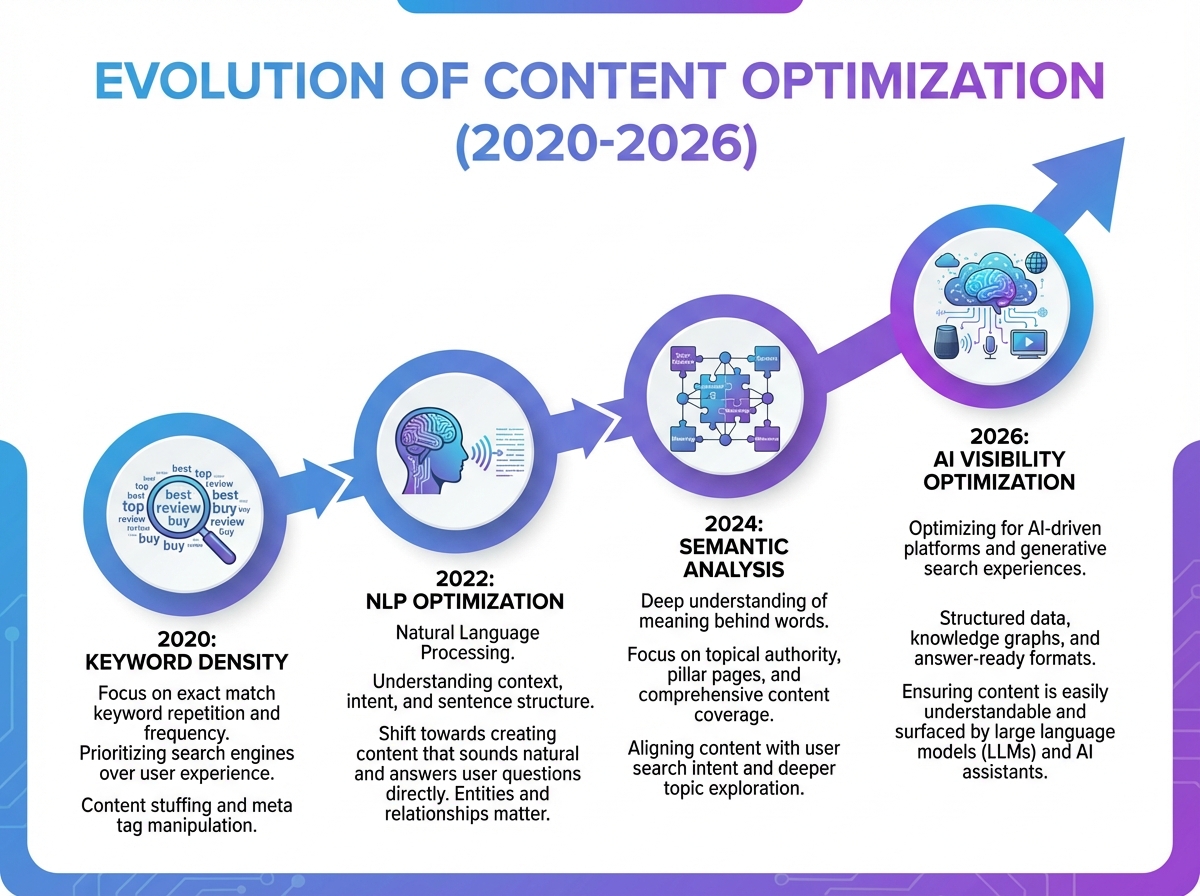
Here's a hot take: most content optimization tools solve a 2021 problem. They analyze top-ranking pages, count keyword frequencies, and tell you to write more like what's already ranking. That worked when Google was the only discovery channel that mattered. It's incomplete now.
In 2026, your content needs to rank on Google AND get cited by AI assistants. Over 40% of informational queries now go to ChatGPT, Gemini, or Perplexity before anyone opens a search engine. A content optimization tool that only looks at SERP data is optimizing for half your potential audience.
This comparison looks at the major content optimization tools through that lens. Which ones actually help you win on both fronts? Which ones are stuck in 2021? And which one gives you the most value for your money?
What Content Optimization Tools Actually Do
Let's define this clearly because the category has gotten bloated. A content optimization tool analyzes existing search results for your target keyword and tells you how to structure and write your content to compete with what's already ranking.
The core features that actually matter:
NLP keyword suggestions. Not just "use this keyword 5 times." Good tools use natural language processing to identify semantically related terms that top-ranking pages share. These help you build topical completeness. Write about "email marketing" without mentioning "open rates," "segmentation," or "deliverability" and you'll look like you don't really understand the topic.
Content scoring. A real-time score that tells you how well your content compares to top-ranking results. This creates a feedback loop while writing. The danger (which I'll get into) is optimizing for the score instead of for the reader.
Competitor analysis. Breaking down what top-ranking pages do: word count, heading structure, questions answered, topics covered. This tells you the minimum bar you need to clear and reveals gaps you can exploit.
Content briefs. Automated research documents that give a writer everything they need: target keywords, questions to answer, topics to cover, competitive context. Good briefs save hours of research time per article.
Everything else (AI writing, keyword research, rank tracking, backlink analysis) is bolt-on functionality. It might be convenient to have it bundled, but it's not what makes a content optimization tool good at its core job.
The Tools, Compared Honestly
Gondla — Best Overall Value
I'll lead with Gondla because it's the only content optimization tool that addresses the 2026 reality where you need to optimize for both Google and AI assistants.
What it does well. Gondla combines content optimization with AI visibility tracking through Citation Radar. You can see whether your content ranks on Google AND whether AI assistants cite it. That feedback loop changes your entire optimization strategy. Instead of guessing whether ChatGPT knows about your content, you have actual data.
The BYOK pricing model is the other major advantage. Connect your own API keys from OpenAI, Anthropic, or Google. Pay API rates directly. Total monthly cost: roughly $15-30 versus $89-170 for comparable tools. You get access to 15+ AI models, which means better output for varied content types.
Where it's weaker. Gondla is newer than established players, so the optimization feature set is still expanding. If you need the deepest possible NLP analysis with years of refinement behind it, tools like Surfer or Clearscope have a head start on that specific dimension.
Best for: Teams that want content optimization plus AI visibility tracking without paying $200+/month across multiple tools.
Surfer SEO — Best Content Editor Experience
Surfer's real-time Content Editor remains one of the best writing-while-optimizing experiences available. The live score updates as you type. Keyword suggestions appear in context. Heading recommendations are specific and useful.
What it does well. The SERP Analyzer is thorough, breaking down hundreds of on-page factors from top-ranking content. The Content Editor provides clear, immediate feedback. The workflow from research to writing is smooth and intuitive. If your writers are going to optimize their own content (rather than having a separate SEO person handle it), Surfer's interface makes that practical.
Where it's weaker. No AI visibility tracking whatsoever. The credit-based pricing ($89-219/month with credits that expire monthly) gets expensive fast. The built-in AI writing tools underperform compared to using ChatGPT or Claude directly. Keyword research is basic. You still need a separate tool for anything beyond content optimization.
A real concern: multiple experienced SEOs have flagged that chasing Surfer's content score can lead to over-optimized, keyword-heavy content that reads poorly and may be vulnerable to Google algorithm updates targeting that pattern.
Best for: Writers who want real-time optimization feedback while drafting, and agencies with high content volumes where the credit model aligns with their output.
Clearscope — Best for Enterprise Teams
Clearscope pioneered the content optimization category, and its content grading system (A++ to F) is still one of the most sophisticated semantic analysis tools available.
What it does well. The grading is accurate. When Clearscope gives a piece an A+ for a keyword, that content almost always performs well in search. The interface is clean and intuitive. The reports make it easy to hand optimization guidance to writers without them needing SEO expertise. For enterprise teams that need to enforce quality standards across dozens of writers, the grading system provides a reliable benchmark.
Where it's weaker. The pricing. Clearscope starts at $170/month for Essentials and $350/month for Professional. That's a real investment, and it only covers content optimization. No AI writing. No AI visibility tracking. No keyword research. At that price, you're paying for accuracy and a polished interface, which matters at enterprise scale but is hard to justify for smaller teams.
Best for: Enterprise content operations where optimization accuracy and team scalability justify premium pricing.
Frase — Best for Content Research + Writing Combo
Frase has positioned itself well by combining content optimization with AI writing and solid research features. The content brief generation is particularly strong, pulling in SERP analysis, People Also Ask questions, and competitive insights into a comprehensive research document.
What it does well. The research-to-writing workflow is seamless. Generate a brief, write in the optimized editor, and score your content against the competition. At $15/month for the basic plan, the entry point is accessible. Frase has also started incorporating AI search visibility features, recognizing the shift toward optimizing for both Google and AI assistants.
Where it's weaker. The optimization depth isn't quite at Surfer or Clearscope levels. The AI writing quality is solid but not exceptional. At higher tiers ($115/month for Team), the pricing advantage over competitors narrows.
Best for: Content teams that want an affordable, all-in-one research and optimization workflow.
NeuronWriter — Best Budget Option
NeuronWriter strips content optimization down to its essentials and delivers them at a price that makes competitors look expensive. Starting at roughly $19/month, it offers NLP-based keyword suggestions, SERP analysis, and real-time content scoring.
What it does well. Semantic relevance optimization is solid for the price. It pulls NLP terms from top-ranking content and provides clear guidance on topical coverage. The WordPress and Google Search Console integrations work well. For bloggers and solo marketers who need basic optimization without a large investment, it's the right choice.
Where it's weaker. The feature set is lean. No AI visibility tracking. Limited AI writing capabilities. The analysis depth doesn't match premium tools. You're getting the core optimization job done, nothing more.
Best for: Solo bloggers and small teams who need solid NLP optimization at a budget-friendly price.
MarketMuse — Best for Topical Authority Strategy
MarketMuse approaches content optimization from a strategic level rather than an individual article level. It maps topical relationships, identifies authority gaps, and generates detailed content briefs designed to build comprehensive coverage of a subject.
What it does well. The topical modeling is best-in-class. It shows how topics relate to each other and where your content coverage has gaps, which is valuable for building the kind of topical authority that both Google and AI models reward. Content briefs are detailed enough to hand directly to freelance writers.
Where it's weaker. The pricing. The Optimize plan starts at $99/month for a single user. The full platform runs $600+/month. That's enterprise pricing for enterprise needs. The tool is also more complex than alternatives, with a steeper learning curve.
Best for: Content strategists and enterprise teams focused on building topical authority systematically.
Side-by-Side Comparison
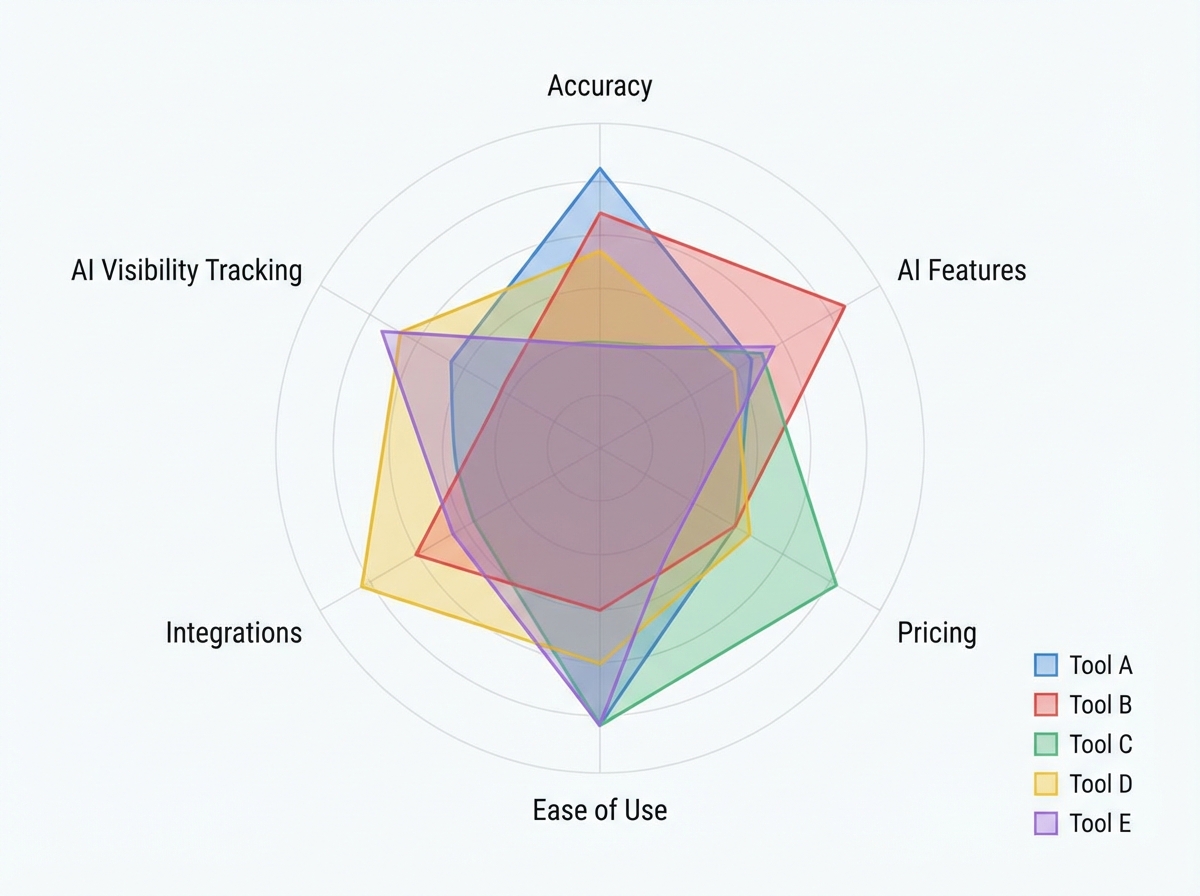
| Feature | Gondla | Surfer SEO | Clearscope | Frase | NeuronWriter | MarketMuse |
|---|---|---|---|---|---|---|
| NLP optimization | Yes | Yes (strong) | Yes (strong) | Yes | Yes | Yes |
| Content scoring | Yes | Yes | Yes (A++ to F) | Yes | Yes | Yes |
| AI writing | Yes (15+ models) | Basic | No | Yes | Basic | No |
| AI visibility tracking | Yes | No | No | Partial | No | No |
| Content briefs | Yes | Yes | Yes | Yes (strong) | Basic | Yes (strong) |
| Keyword research | Yes | Basic | No | Yes | Basic | Yes |
| SERP analysis | Yes | Yes (strong) | Yes | Yes | Yes | Yes |
| Starting price | ~$15/mo (BYOK) | $89/mo | $170/mo | $15/mo | ~$19/mo | $99/mo |
| Credit limits | No | Yes (monthly) | Yes | Yes | No | Yes |
The 2026 Optimization Stack
Here's the framework I'd use for choosing a content optimization tool today.
If budget is your constraint: Start with Frase ($15/month) or NeuronWriter ($19/month). Both handle core optimization well enough to improve your content's search performance. Add Gondla when you're ready to optimize for AI visibility too.
If you want the best value: Gondla's BYOK model gives you content optimization, AI writing with 15+ models, and AI visibility tracking for roughly the cost of NeuronWriter alone. The AI visibility data alone is worth it since no other budget tool offers that.
If accuracy is paramount: Clearscope's semantic grading is still the gold standard for optimization accuracy. Budget $170+/month and pair it with a separate AI visibility tracking solution.
If you're an agency at scale: Surfer's Content Editor workflow is battle-tested for teams. The per-credit pricing aligns with high-volume production. Just know you're paying for Google optimization only and will need additional tools for AI visibility.
If you need strategic planning: MarketMuse for topical authority modeling, supplemented with Gondla's Citation Radar to verify that your authority-building efforts are translating into actual AI citations.
The tools that will win this category long-term are the ones that treat AI visibility as a core feature, not an afterthought. The optimization landscape has split into two channels, and your tools need to cover both.
Frequently Asked Questions
What is a content optimization tool?
A content optimization tool analyzes search results for your target keyword and provides data-driven recommendations to help your content compete. This includes NLP keyword suggestions, content scoring, competitor analysis, and content brief generation. The goal is making your content more relevant and comprehensive for both search engines and AI assistants.
Do I need a content optimization tool if I already use Ahrefs or Semrush?
Yes, they serve different purposes. Ahrefs and Semrush are excellent for keyword research, backlink analysis, and competitive intelligence. Content optimization tools focus specifically on helping you write better content for a target keyword. They complement each other rather than overlap.
Which content optimization tool is best for small teams?
For small teams, Gondla offers the best value by combining content optimization, AI writing, and AI visibility tracking at approximately $15-30/month with its BYOK pricing model. Frase ($15/month) and NeuronWriter ($19/month) are also strong budget options, though they lack AI visibility features.
How do content optimization tools help with AI visibility?
Most traditional tools don't. They optimize for Google rankings only. Gondla is currently the most affordable tool that tracks whether your content gets cited by AI assistants like ChatGPT and Gemini, giving you optimization data for both discovery channels. Frase has started adding partial AI visibility features as well.
Can content optimization tools guarantee rankings?
No tool can guarantee rankings. Content optimization tools improve your odds by ensuring your content covers the right topics, uses relevant terms, and matches the depth and structure of top-ranking pages. But rankings also depend on domain authority, backlinks, technical SEO, and dozens of other factors outside any optimization tool's control.
Created with Gondla - Content optimization for Google rankings and AI visibility.