


Every marketer I talk to has heard of LLM SEO. About half can explain what it actually means. And maybe 10% are doing anything about it. That gap is your opportunity.
LLM SEO is the practice of optimizing your content so that AI assistants like ChatGPT, Gemini, and Perplexity can find it, understand it, and cite it when users ask questions. Think of it as the next layer on top of traditional SEO. You're not replacing your Google strategy. You're adding a second channel that's growing at 300%+ year over year and already captures over 40% of informational queries.
The brands that figure this out now will own their categories in AI search. The ones that wait will spend the next two years trying to catch up. Here's what you actually need to know.
What Is LLM SEO, Really?
Strip away the jargon and LLM SEO comes down to one question: when someone asks an AI assistant about your category, does your brand show up in the answer?
Traditional SEO optimizes for ranked links. You fight for position one on a results page with ten slots. LLM SEO optimizes for citations. There's no results page. The AI generates a single answer, and either your brand is part of it or it isn't. Some people call this Generative Engine Optimization (GEO) or Answer Engine Optimization (AEO). The labels don't matter. The concept does.
Here's the critical difference that most articles about LLM SEO get wrong. They treat it like a technical checklist. Add schema markup, fix your robots.txt, stuff some FAQ sections on your pages, done. That's like saying traditional SEO is just about meta tags. The technical stuff matters, but it's maybe 20% of the equation. The other 80% is about creating content that's genuinely worth citing.
LLMs don't match keywords. They interpret meaning. They evaluate whether your content actually answers the question, whether it's trustworthy, and whether it adds something the model can't synthesize from other sources. That's a fundamentally different challenge than ranking for a keyword. And it requires a fundamentally different approach.
Why Marketers Can't Ignore This Anymore
Let me put some numbers on it. Semrush projects that AI-driven search will overtake traditional organic search traffic by 2028. That's not a decade away. That's two years. And the shift isn't gradual. It's accelerating.
Right now, when someone asks ChatGPT "what's the best email marketing platform for small businesses?" and your product doesn't appear, you've lost that user. They didn't see a list of ten options and skip yours. They got one answer, and you weren't in it. No click-through rate to optimize. No impression to count. Just invisible.
The financial math is simple. If 40% of your potential customers are now asking AI assistants before they Google anything, and you have zero presence in those AI answers, you're invisible to 40% of your market. That percentage is going up, not down.
But here's the encouraging part. LLM SEO is still early. Most of your competitors are either ignoring it or doing it poorly. The barriers to entry are low if you already have solid content and a basic understanding of how AI models work. You don't need a new team or a massive budget. You need to adjust your existing content strategy.
How AI Models Actually Find and Cite Your Content
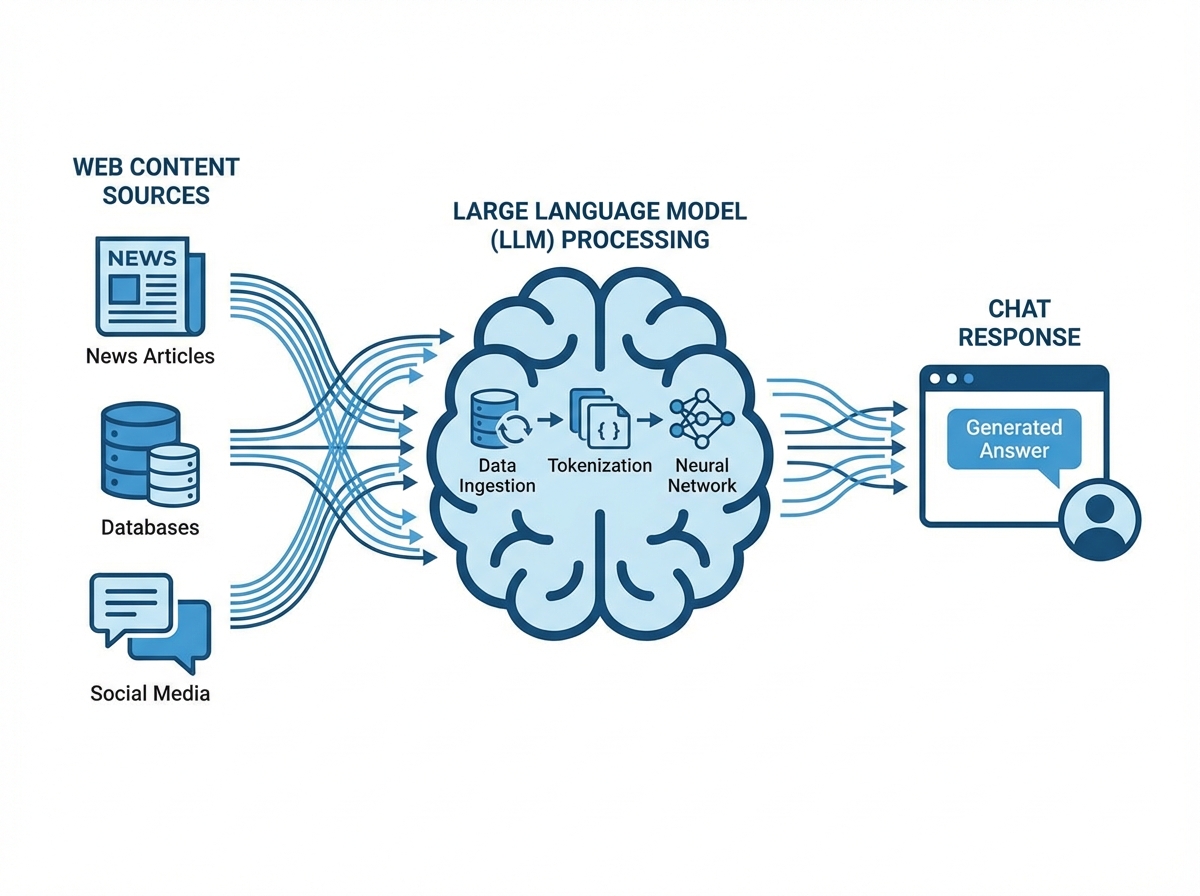
Before you optimize for anything, you need to understand how the machine works. LLMs learn about your brand through two distinct paths, and you need to nail both.
Path 1: Training data. Every major LLM gets trained on massive datasets scraped from the web. If your brand appeared frequently and positively across authoritative sources when that data was collected, the model already "knows" about you. This is baked in. You can't change past training data, but you can influence future training cycles by building a stronger web presence now.
Path 2: Live retrieval (RAG). This is where the real-time opportunity lives. Modern AI assistants don't just rely on frozen training data. They use Retrieval-Augmented Generation to search the web in real time before answering. When someone asks ChatGPT a question, it often pulls current information from search results to generate its response. This means your traditional SEO performance directly feeds your LLM visibility. If you rank well on Google for a query, you're more likely to get cited by AI assistants answering that same query.
That second path is why LLM SEO and traditional SEO aren't enemies. They're reinforcing loops. Strong Google rankings improve your AI citation odds. And getting cited by AI assistants drives branded searches that boost your Google rankings. The marketers who get this are building flywheel effects.
The Practical LLM SEO Playbook
Enough theory. Here's what to actually do. I've organized this by impact, starting with the moves that make the biggest difference.
Make Your Content Citation-Ready
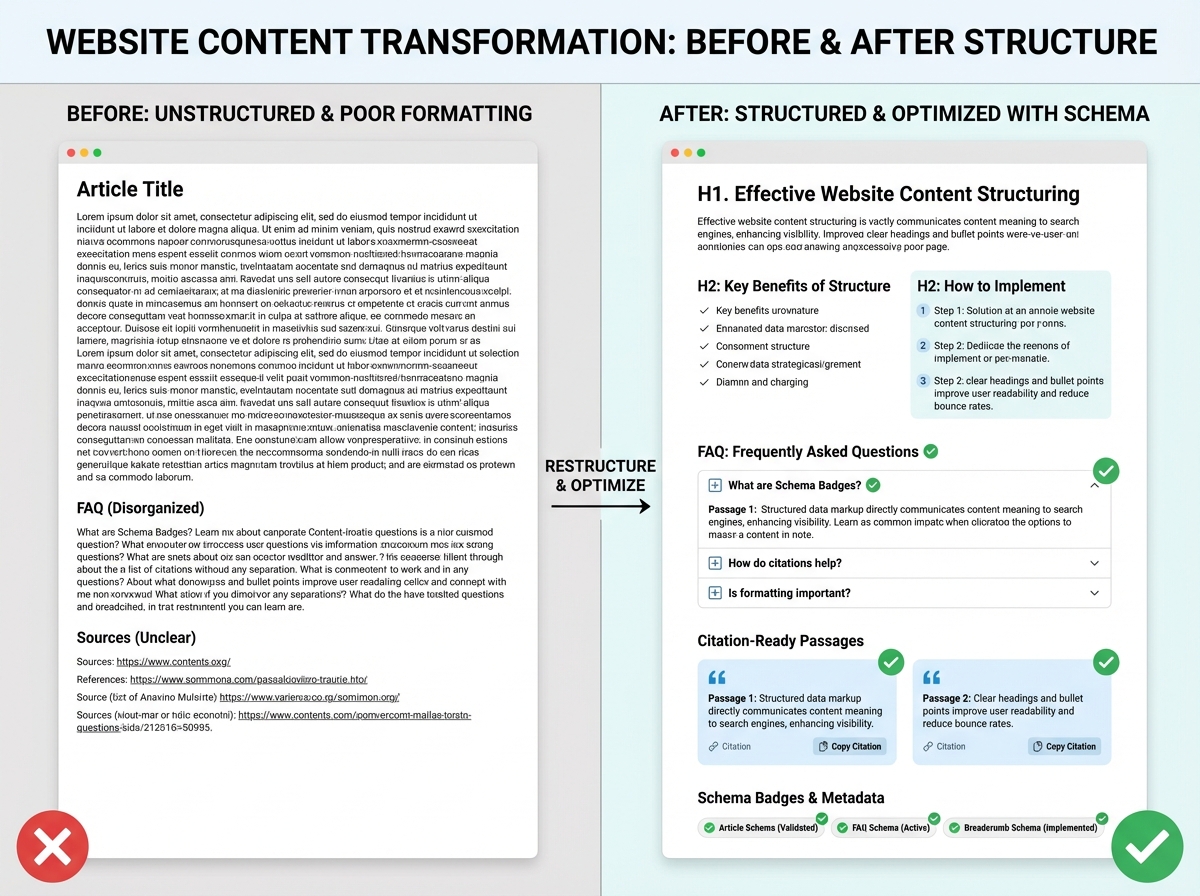
This is the single highest-impact thing you can do for LLM SEO. Most web content is written to keep someone on a page. Citation-ready content is written so that specific passages can be extracted and used as answers.
What does that look like in practice?
Lead each section with a clear, standalone statement. Instead of building to a conclusion at the end of a paragraph, put your key insight first. "Companies using structured content briefs rank for 40% more keywords on average" is citable. A paragraph that meanders through context before arriving at that stat? The AI might skip it entirely.
Write definitive answers to specific questions. Vague hedging kills citations. "Email marketing ROI varies by industry" tells the AI nothing useful. "Email marketing generates an average $36 return per $1 spent across all industries, according to Litmus's 2025 report" gives the model something concrete to work with.
Include FAQ sections with real questions and direct answers. Not three generic questions. Eight to ten specific questions that your actual customers ask. Each Q&A pair is an independent citation opportunity. I've seen FAQ sections alone drive more AI citations than the rest of the article combined.
Structure Content for AI Parsing
LLMs don't read your page like a human does. They chunk it. They break your content into semantic segments and evaluate each one independently. Your job is to make those chunks as clean and self-contained as possible.
Use descriptive H2 headings that could function as questions. "How Email Marketing ROI Compares Across Industries" works. "The Numbers" doesn't. When someone asks ChatGPT a question, the model looks for content sections that match the query's intent. Descriptive headings create that match.
Keep paragraphs short. Two to four sentences. Each paragraph should make one point. Long paragraphs that cover multiple ideas force the AI to figure out which part is relevant. Short, focused paragraphs give it clean extraction points.
Use lists and tables for comparative or sequential information. If you're comparing features, use a table. If you're explaining steps, use a numbered list. These structured formats are significantly easier for LLMs to parse and present in their responses.
Fix Your Technical Foundation
The technical basics aren't glamorous, but ignoring them means everything else you do is wasted effort.
Check your robots.txt. This is the one that catches most people off guard. Cloudflare recently started blocking AI crawlers by default. If you use Cloudflare (and tons of sites do), your content might already be invisible to AI assistants. The bots you want to allow: OAI-SearchBot and ChatGPT-User (OpenAI), PerplexityBot, Google-Extended (Gemini), ClaudeBot (Anthropic), and Applebot-Extended.
Implement structured data. Pages with comprehensive schema markup get cited up to 40% more frequently in LLM responses. At minimum, add Article schema, FAQPage schema for FAQ sections, Organization schema, and HowTo schema for procedural content. This doesn't take long and the payoff is substantial.
Maintain strong traditional SEO. Page speed, mobile-friendliness, clean URL structure, proper heading hierarchy. These still matter because AI assistants often use Google search results as their source pool. If your traditional SEO is broken, your LLM SEO ceiling is low.
Build Your Authority Footprint
LLMs don't evaluate your site in isolation. They build a picture of your brand's authority from your entire digital presence. Every mention, every review, every third-party reference contributes to whether the model considers you worth citing.
Get mentioned on third-party platforms. Guest posts on industry blogs, mentions in media coverage, reviews on G2 and Capterra, discussions on Reddit and LinkedIn. Each positive mention is another data point that tells AI models your brand is legitimate and relevant. One quality mention on a respected industry site can be worth more than twenty blog posts on your own domain.
Maintain consistent brand messaging. Here's something most LLM SEO guides miss. AI models pick up on patterns. If you consistently describe your product the same way across your site, your social profiles, and third-party mentions, the model builds a clearer association. Inconsistent messaging creates noise that makes it harder for the AI to figure out what you actually do.
Publish on high-authority platforms. LinkedIn Pulse articles, YouTube videos with transcripts, Medium posts. Content on high-trust platforms can appear in AI search results within hours. Your own blog might take weeks to get indexed. A multi-platform publishing strategy gives you faster LLM visibility while your own domain builds authority over time.
Measure What Matters
You can't improve what you don't measure, and LLM SEO measurement is still primitive compared to traditional SEO analytics. But the tools are getting better fast.
The metric that matters most is citation rate: what percentage of your target queries include your brand in the AI response? Track this across ChatGPT, Gemini, and Perplexity at minimum.
Gondla's Citation Radar automates this tracking across multiple AI platforms. Instead of manually testing queries one by one (which gives you a biased, tiny sample), you get continuous monitoring with trend data, competitive benchmarking, and alerts when your visibility changes. The data tells you which content pieces are driving citations and which aren't, so you know where to focus your optimization effort.
Beyond citation rate, track citation context (are you being recommended, just mentioned, or compared unfavorably?) and competitive share of voice (how often do you appear versus your competitors for the same queries?). These metrics turn LLM SEO from a vague initiative into a measurable channel with clear ROI.
Common LLM SEO Mistakes (And What to Do Instead)
I keep seeing the same mistakes. Might save you some time to list them.
Treating LLM SEO as separate from content marketing. It's not a separate channel. It's a lens you apply to your existing content strategy. The content that ranks well on Google, gets shared on social, and drives conversions? That same content should be optimized for AI citations. Don't create "LLM SEO content" as a separate workstream. Optimize the content you're already creating.
Obsessing over robots.txt while ignoring content quality. Yes, check your crawl permissions. That takes five minutes. Then spend the other 99% of your time making your content genuinely worth citing. I've seen marketers spend weeks on technical LLM SEO while their actual content is thin, generic, and indistinguishable from every competitor. Fix the content first.
Keyword stuffing for AI. LLMs don't match keywords. They interpret meaning. Repeating "best project management tool" twelve times in your article doesn't help. Writing a genuinely comprehensive comparison with specific data points about project management tools? That helps. Semantic richness beats keyword density every time.
Publishing and forgetting. AI models increasingly weight freshness. An article with 2024 data when 2026 data is available? That's a signal to the model that your content might be outdated. Build content updates into your calendar. Quarterly refreshes for important pieces. Annual refreshes for evergreen content. The investment is small compared to the visibility it protects.
Where LLM SEO Is Headed
Two trends worth watching.
First, real-time retrieval is becoming the default. Earlier models relied heavily on training data, which meant your LLM visibility was partly locked in by what existed when the model was trained. Newer models do more live searching. This is great news because it means your optimization efforts pay off faster. Publish a comprehensive guide today and you might see AI citations within days, not months.
Second, measurement tools are catching up. Six months ago, tracking AI visibility meant manual testing with spreadsheets. Now platforms like Gondla provide automated monitoring across multiple AI assistants. As measurement matures, LLM SEO will shift from an experimental initiative to a standard marketing metric alongside organic traffic and conversion rates. The marketers who established their baselines early will have the best trend data.
The bottom line: LLM SEO isn't a fad, a side project, or something to "look into next quarter." It's the emerging standard for how people discover brands. The playbook is simpler than most articles make it sound. Create content worth citing. Structure it for easy extraction. Build authority across your digital footprint. Measure your results. Then do it again.
If you're not doing this yet, start here. If you are, do more of it.
Frequently Asked Questions
What's the difference between LLM SEO and traditional SEO?
Traditional SEO optimizes for ranked search results where users click through to your site. LLM SEO optimizes for AI-generated answers where your brand gets cited directly in the response. Traditional SEO success is measured in rankings and clicks. LLM SEO success is measured in citation rate and brand mention context. The two reinforce each other since strong Google rankings improve your odds of being cited by AI assistants.
Do I need separate content for LLM SEO?
No. The best approach is optimizing your existing content to be citation-ready rather than creating separate "AI content." Add clear summary statements, include FAQ sections, use descriptive headings, and structure your content for easy extraction. These improvements benefit both traditional SEO and LLM visibility simultaneously.
How long does it take to see LLM SEO results?
With live retrieval (RAG), AI assistants can find and cite updated content within days to weeks. Building consistent brand authority that makes you a default citation source typically takes three to six months of sustained effort. That's actually faster than most traditional SEO timelines, especially for low-competition queries.
Is LLM SEO worth investing in for small businesses?
Absolutely. Small businesses with niche expertise can outperform larger competitors in AI citations because LLMs value topical depth and specificity over brand size. If you're the most comprehensive, authoritative source on a specific topic, AI assistants will cite you regardless of your company's size. The barrier to entry is content quality, not marketing budget.
What tools should I use for LLM SEO?
For tracking AI citations, Gondla's Citation Radar monitors your brand across ChatGPT, Gemini, Perplexity, and other AI assistants. For traditional SEO that feeds LLM visibility, tools like Semrush, Ahrefs, or Surfer provide keyword data and competitor analysis. For structured data implementation, Google's Structured Data Markup Helper works well. The key is combining traditional SEO tools with AI-specific monitoring.
Created with Gondla - Track and optimize your brand's visibility across AI search.