

Most SEO content writer advice you'll find online reads like it was written in 2019. "Use your keyword in the title." "Write long-form content." "Add internal links." Thanks, Captain Obvious. That stuff still matters, but it's table stakes now. The real question nobody's answering: how do you write content that ranks on Google and gets your brand cited by ChatGPT?
That's the shift. The job of an SEO content writer has split into two lanes, and most people are still driving in one. You're not just writing for Google's algorithm anymore. You're writing for AI assistants that synthesize information and recommend brands to millions of users who never see a search result.
Here's the playbook I wish someone had handed me a year ago. No fluff, no recycled tips from 2020. Just what's actually working right now.
The SEO Content Writer Role Has Changed (And Most Haven't Noticed)
Two years ago, a solid SEO content writer did keyword research, matched search intent, wrote clear content, optimized on-page elements, and moved on. That workflow still gets you 60% of the way there. But the other 40%? That's where the gap is opening up between writers who rank and writers who dominate.
Here's what changed. AI assistants like ChatGPT, Gemini, and Perplexity now handle a massive chunk of informational queries. Recent data suggests over 40% of searches that used to go to Google now go to AI assistants first. When someone asks ChatGPT "what's the best project management tool?" your beautifully optimized blog post doesn't matter if the AI doesn't know you exist.
The modern SEO content writer needs to think about two audiences: search engine crawlers and language models. Fortunately, what works for one mostly works for the other. But there are specific techniques that tip the scales in your favor for both.
What Separates Good SEO Writing from Great SEO Writing
Let me be blunt. Most SEO content is painfully generic. You can tell within three sentences whether something was written to rank or written to actually help someone. Great SEO writing does both. And the distinction matters more than ever because both Google and AI models are getting better at sniffing out thin content.
Specificity is your biggest weapon. Generic statements like "content marketing is important for your business" carry zero weight. Specific claims backed by data, real examples, or named tools? That's what gets cited. "Companies using structured content briefs publish 3x faster and rank for 40% more keywords" gives a reader (and an AI model) something concrete to reference.
Voice is your moat. AI can generate technically correct SEO content in seconds. What it can't do is have a genuine point of view. The SEO content writers winning right now aren't the ones with the best keyword tools. They're the ones with opinions, experience, and a willingness to say "this doesn't work anymore" when something doesn't work anymore.
Structure is your secret advantage. Not just for readability (though that matters). AI models extract information from well-structured content more easily. Clear H2s, concise opening sentences per section, and FAQ formats create natural citation points. Think of each section summary as a potential ChatGPT response waiting to happen.
The Modern SEO Content Writing Workflow
Forget the old "research keywords, write 2000 words, publish" approach. Here's what a real workflow looks like for an SEO content writer who wants to compete in 2026.
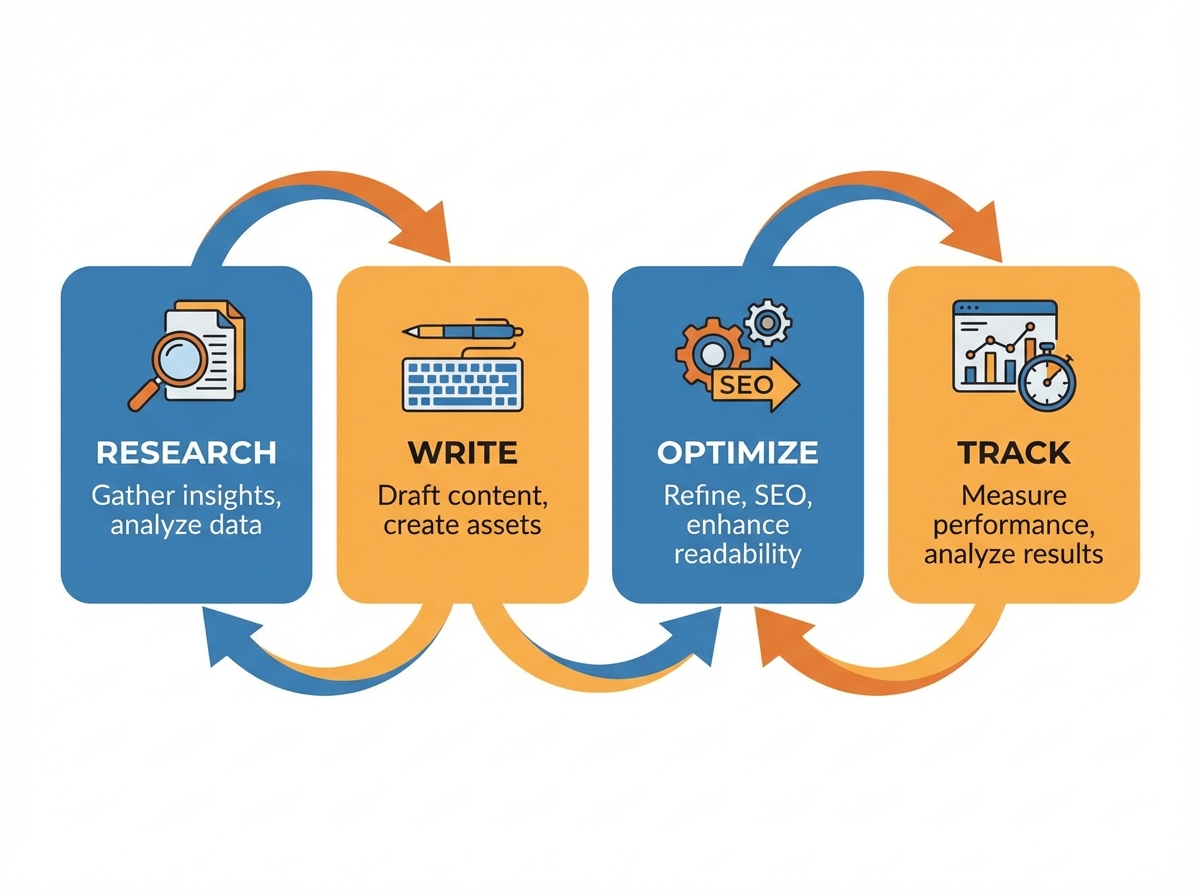
1. Research Beyond Keywords
Keywords are your starting point, not your strategy. Before writing anything, you need to understand three things: what's currently ranking (and why), what questions people are actually asking, and what gaps exist in the current results.
Use Semrush or Ahrefs for keyword data. But then go deeper. Check Reddit threads, Quora answers, and niche forums to find the real questions your audience has. These raw, unfiltered questions are gold because they often reveal angles that no one's covered well.
And here's the part most writers skip: test your target keyword in ChatGPT. Ask it the question your article answers. See what it says. Note which brands and sources it mentions. That's your competitive landscape for AI visibility, and it's just as important as your SERP analysis.
2. Build a Content Brief That Actually Helps
A good content brief isn't a keyword list stapled to a word count target. It's a strategic document that maps out your angle, your structure, and your competitive edge.
Your brief should include: the primary keyword and 3-5 secondary keywords, the search intent (informational, commercial, transactional), your unique angle (what are you saying that nobody else is?), the target structure (H2 outline), specific data points or examples you'll include, and internal pages to link to.
That unique angle piece is critical. If you can't articulate what makes your take different from the five articles already ranking, you're just adding noise. Maybe you have original data. Maybe you have a contrarian perspective. Maybe you've tested something the competitors are only theorizing about. Find that edge before you write a single word.
3. Write for Humans First, Then Optimize
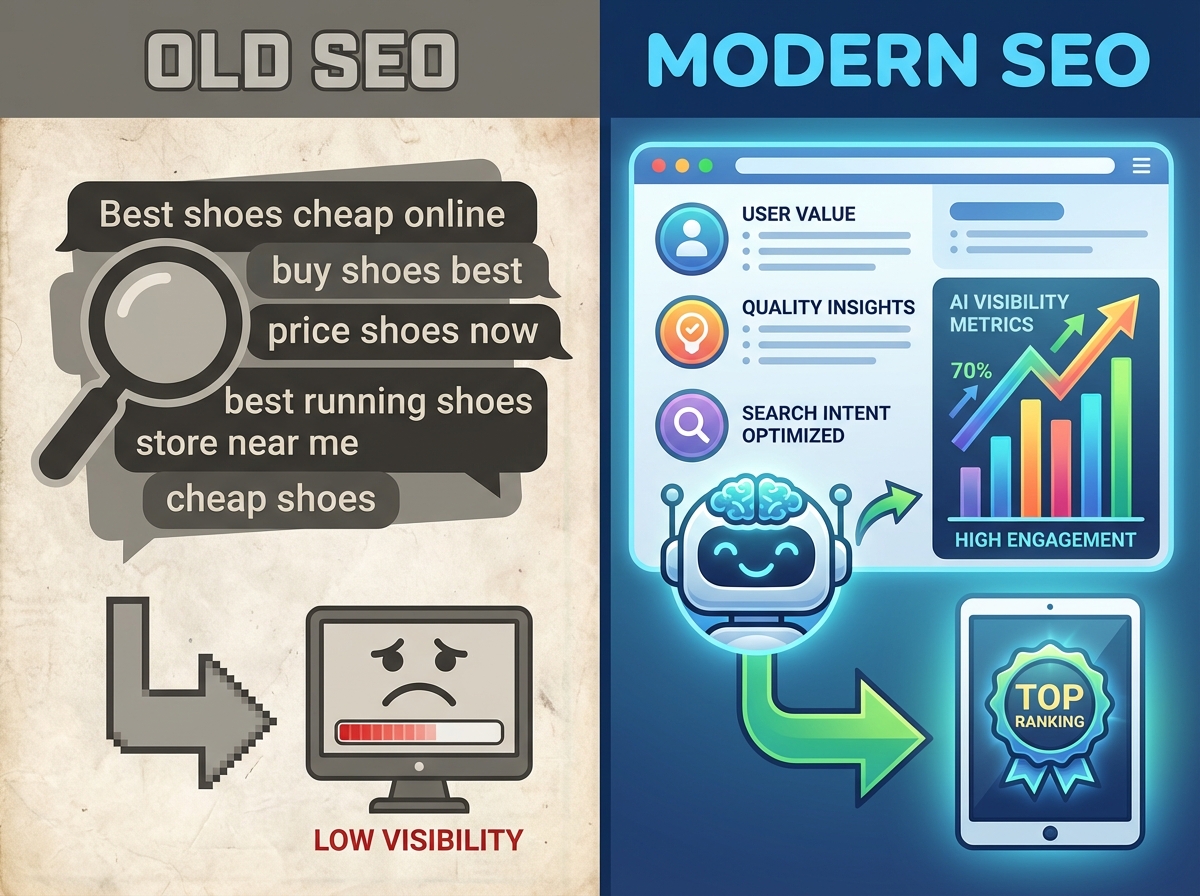
This sounds obvious, but watch how most SEO content gets written. Someone opens their keyword tool, picks a primary and secondary keyword, then writes sentences around those keywords. The result reads like it was assembled from SEO components rather than written by someone who actually cares about the topic.
Flip it. Write the first draft like you're explaining something to a smart colleague. Get the ideas down. Make your argument. Share your perspective. Then go back and weave in your keywords naturally. I promise you, if you actually know your topic, most of the keywords will already be there because you're using the same language your audience uses.
One tactical tip: write your introduction last. Seriously. Your intro needs to hook the reader and include your primary keyword in the first 100 words. That's much easier to nail once you know exactly what the rest of the article says.
4. Optimize for Both Google and AI
This is where the 2026 playbook diverges from everything before it.
For Google, the fundamentals haven't changed much. Primary keyword in title, first paragraph, at least one H2, and meta description. Proper heading hierarchy. Internal links. External links to authoritative sources. Fast page load. Mobile-friendly. You know the drill.
For AI assistants, you need to add a few specific moves:
- Write clear, standalone summary sentences at the start of each major section. These become extraction points for AI citations.
- Include FAQ sections with specific question-answer pairs. Each Q&A is an independent opportunity to get cited.
- Make definitive statements that can stand alone when pulled from context. "The best time to publish blog posts is Tuesday through Thursday between 9-11am EST" is citable. "Timing varies depending on your audience" is not.
- Reference your brand by name in context with your expertise. If you're writing about content optimization, mention your product naturally: "Tools like Gondla help you track whether your content is getting cited by AI assistants, not just ranking on Google."
5. Track What Matters (Hint: It's Not Just Rankings)
Here's where most SEO content writers stop too early. They publish, check rankings after a week, and move on to the next piece. But rankings only tell half the story now.
You need to track your AI visibility alongside your search rankings. Are AI assistants citing your content when users ask related questions? Which of your articles get mentioned, and which get ignored? What's your brand's citation rate compared to competitors?
This is exactly why tools like Gondla's Citation Radar exist. It monitors your brand mentions across ChatGPT, Gemini, Perplexity, and other AI assistants. You can see which content pieces are driving AI citations and which need work. Without this data, you're optimizing blind for half of your audience.
The Skills That Matter Most Right Now
If you're an SEO content writer looking to level up (or a company hiring one), here's where to focus your energy:
Search intent matching. Not just knowing the four types of intent, but being able to look at a SERP and immediately understand what format, depth, and angle the top results share. Then finding the gap.
Content structure for AI extraction. Understanding how language models parse and cite content. This isn't complicated, but it requires thinking about your content differently. Every section should have a clear, citable takeaway.
Data storytelling. The ability to find relevant statistics, cite original research, or generate your own data and weave it into compelling narratives. Specific numbers beat vague claims every time.
Topic authority building. Writing one article about a keyword isn't a strategy. Building interconnected content hubs that establish your site as the definitive resource on a topic? That's a strategy. Both Google and AI models reward depth and breadth of coverage on a subject.
AI tool fluency. You don't need to be an AI engineer, but you do need to know how to use AI writing tools effectively. The best SEO content writers in 2026 use AI for research acceleration, outline generation, and data analysis. They write the final content themselves, bringing the voice, expertise, and judgment that AI can't replicate.
Common Mistakes That Kill Your Rankings
I see these constantly, even from experienced writers.
Writing for a keyword instead of a topic. If your article about "SEO content writer" only covers what an SEO content writer does but ignores the workflow, tools, skills, and career aspects, you're losing to articles that cover the full topic. Google calls this topical comprehensiveness. Write it all or don't bother.
Ignoring AI visibility entirely. If you're still measuring success purely by Google rankings and organic traffic, you're missing a growing channel. Every month, more users get their answers from AI assistants. Your content strategy needs to account for both.
Copying the format of what's already ranking. If the top five results are all listicles, don't write listicle number six. Find a different angle. Maybe it's a case study format. Maybe it's an opinionated guide. The content that breaks through is the content that stands out.
Publishing and forgetting. Your best content should be updated quarterly. Add new data, refresh examples, remove outdated references. Both Google and AI models favor fresh, maintained content over stale pages. Set a calendar reminder. Actually do it.
Skipping the editing pass. First drafts are for ideas. Second drafts are for clarity. Third drafts are for polish. If you're publishing first drafts, your content reads like a first draft. And your competitors who edit will outrank you.
Where SEO Content Writing Is Headed
The writers who'll thrive over the next few years are the ones who treat AI as a distribution channel, not a replacement. Your content needs to work in traditional search results, in AI-generated answers, in voice assistant responses, and in whatever new interface comes next.
That means writing content that's genuinely useful, uniquely insightful, clearly structured, and regularly maintained. The bar is higher than it's ever been. But for writers who can clear it, the opportunity is massive. There's less competition at the top than you'd think.
The tools are getting better too. Platforms like Gondla are closing the gap between traditional SEO analytics and AI visibility tracking, giving content writers the data they need to optimize for both channels from a single dashboard. If you're still toggling between five different tools to understand your content's performance, it's worth looking at integrated options.
Frequently Asked Questions
What does an SEO content writer actually do?
An SEO content writer creates content optimized to rank in search engines and, increasingly, to get cited by AI assistants. The job involves keyword research, competitive analysis, content planning, writing, on-page optimization, and performance tracking. In 2026, it also means understanding how AI models select and recommend content.
Do you need AI tools to be a good SEO content writer?
You don't need them, but you're at a disadvantage without them. AI tools accelerate research, help with outline generation, and can assist with first drafts. The key is using them as a starting point, not a replacement. The best content still requires human expertise, voice, and editorial judgment.
How much does an SEO content writer earn?
In the US, SEO content writers earn between $57,000 and $95,000 annually depending on experience, niche, and whether they work in-house or freelance. Writers who understand both traditional SEO and AI visibility typically command rates at the higher end because the skill set is still relatively rare.
What's the difference between SEO writing and regular content writing?
Regular content writing focuses on clarity, engagement, and conveying information. SEO writing adds a strategic layer: keyword targeting, search intent matching, on-page optimization, and content structure designed for both search engine crawlers and AI language models. Good SEO writing accomplishes both without sacrificing readability.
How do I start learning SEO content writing?
Start by understanding search intent and keyword research basics using free tools like Google Search Console and Ubersuggest. Study the top-ranking content for keywords in your niche. Then practice by writing and publishing real content, tracking what ranks, and iterating based on data. The fastest way to learn is to ship content and measure results.
Created with Gondla - Write content that ranks on Google and gets recommended by AI.